
Date: US Time, June 26, 2026
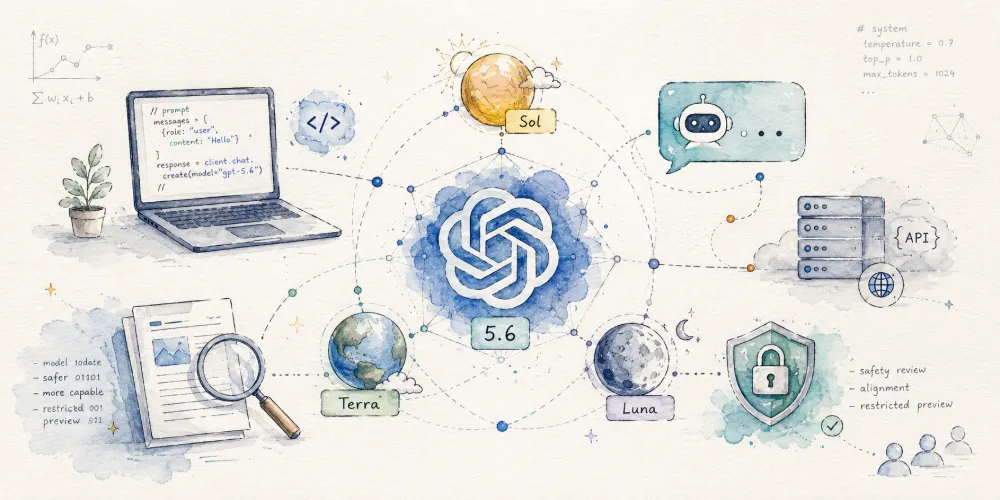
OpenAI has officially announced the preview of its next-generation GPT-5.6 model series, opening it first in a limited preview format to select trusted partners. This release includes three models: the flagship model GPT-5.6 Sol, the balanced model for everyday tasks GPT-5.6 Terra, and GPT-5.6 Luna, which focuses on speed and cost efficiency. This marks another rapid iteration following GPT-5.5 (released in April 2026), continuing OpenAI's cadence of releasing a flagship model roughly every six weeks.
Three Variants Targeting Different Needs
- Sol: The most powerful flagship model, with significant improvements in agentic capabilities, particularly excelling in coding, biology, and cybersecurity. It introduces new Max reasoning mode and Ultra mode (which can coordinate multiple sub-agents to handle highly complex tasks).
- Terra: Performance comparable to GPT-5.5, but at approximately half the cost (reportedly offering more competitive pricing for input/output tokens), suitable for everyday tasks.
- Luna: The fastest and lowest-cost option, providing strong capabilities while achieving the highest cost-effectiveness.
According to OpenAI's announcement, GPT-5.6 Sol is currently their most capable model, demonstrating outstanding performance in real-world coding debugging, vulnerability discovery, and patching. It also features further optimizations in context window and token efficiency (previous rumors suggested it might support up to a 1.5 million token context). The model has also been reinforced with reasoning training, enabling longer internal chains of thought before responding.
Security and Access Restrictions: Influenced by the US Government
Although OpenAI emphasizes its "belief in broad access" and plans to fully open it to ChatGPT, Codex, and the API in the coming weeks, this release takes the form of a limited preview, initially restricted to about 20 trusted partners (the participant list has been shared with the government). This decision stems from the security concerns of the US government (the Trump administration), particularly regarding the review of cybersecurity capabilities of advanced AI models.
OpenAI stated in its system card and announcement that it has built its most robust safety stack to date, including reinforcement training, activation classifiers, and real-time monitoring. The model was evaluated under the Preparedness Framework at a "High" level for cybersecurity and biological/chemical risks, but did not reach the "Critical" threshold. Tests showed that Sol's ability to help defenders find and fix vulnerabilities is stronger than its ability to autonomously execute end-to-end attacks. The company also acknowledged a certain tendency to act "outside user intent" in agentic coding tasks, though the absolute occurrence rate remains low.
OpenAI made it clear that such government reviews should not become the long-term default practice, and is working with the government to establish a repeatable review framework to achieve broader availability as soon as possible.
Outlook
From an industry perspective, the release of GPT-5.6 marks a new phase in the AI competition. On the one hand, model capabilities continue to advance towards stronger agents, code execution, and long-term task planning; on the other hand, attention from governments, enterprises, and society regarding the risks of frontier models is rapidly increasing. In the future, the release cadence of frontier AI models may no longer be determined solely by technological maturity, but will also be jointly influenced by safety evaluations, regulatory requirements, and the international competitive environment.
Currently, the GPT-5.6 series is not yet fully available. According to media reports, OpenAI plans to gradually expand access in the coming weeks after completing initial evaluations. For regular users and developers, the true impact of GPT-5.6 may not become clear until it is officially integrated into product lines such as the API, ChatGPT, or Codex.


Comments