
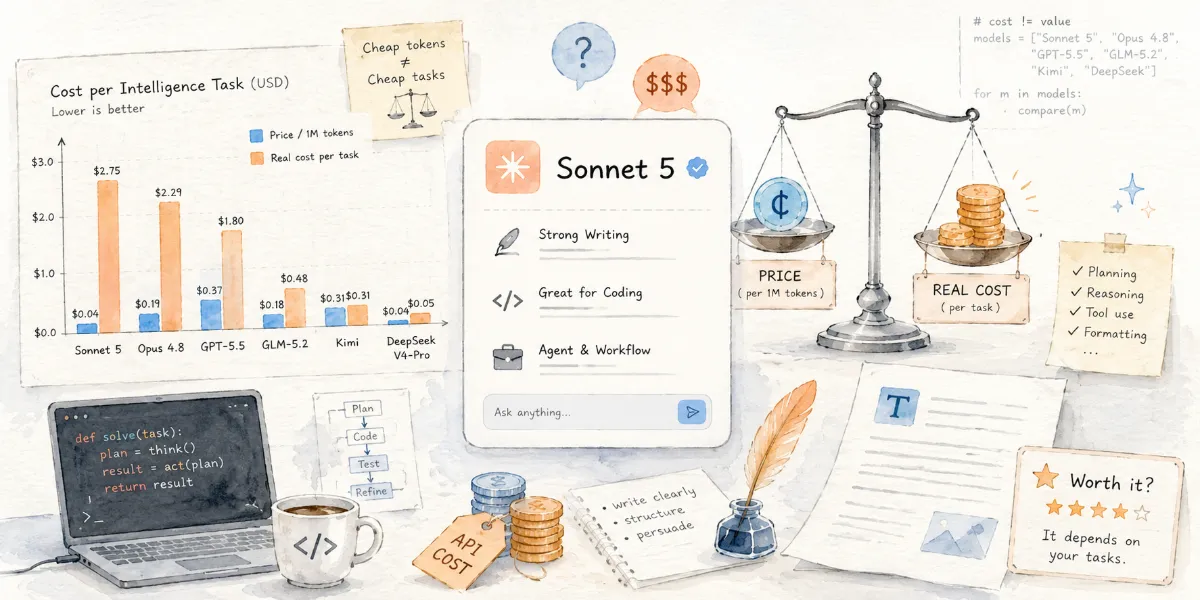
On July 1, 2026, Beijing time, Anthropic announced that the ban on Fable 5 has been lifted and released their new model, Sonnet 5. Anthropic claimed that this version significantly improves agent capabilities for autonomous task execution and tool calling, with performance approaching the flagship Opus 4.8, and features a brand-new tokenizer. The pricing details are as follows:
| Model | Input (per M Tokens) | Output (per M Tokens) | Notes |
|---|---|---|---|
| Sonnet 5 | $3 | $15 | Promotional price of $2 / $10 before August 31 |
| Opus 4.8 | $5 | $25 | Unlimited-time promotional price |
| Fable 5 | $10 | $50 | Not included Claude Pro/MAX after July 7; API billing only. |
Whether for input or output, the unit price of Sonnet 5 is only 60% of Opus. However, a lower unit price does not necessarily mean it's more cost-effective. As we will discuss later, measured by actual task cost, Sonnet 5 might end up costing more to complete the same task—which is the source of the controversy.
With a lower unit price compared to Opus and a major version jump, you might wonder: is Sonnet 5 really worth using?
Conclusion
Let's jump straight to the conclusion:
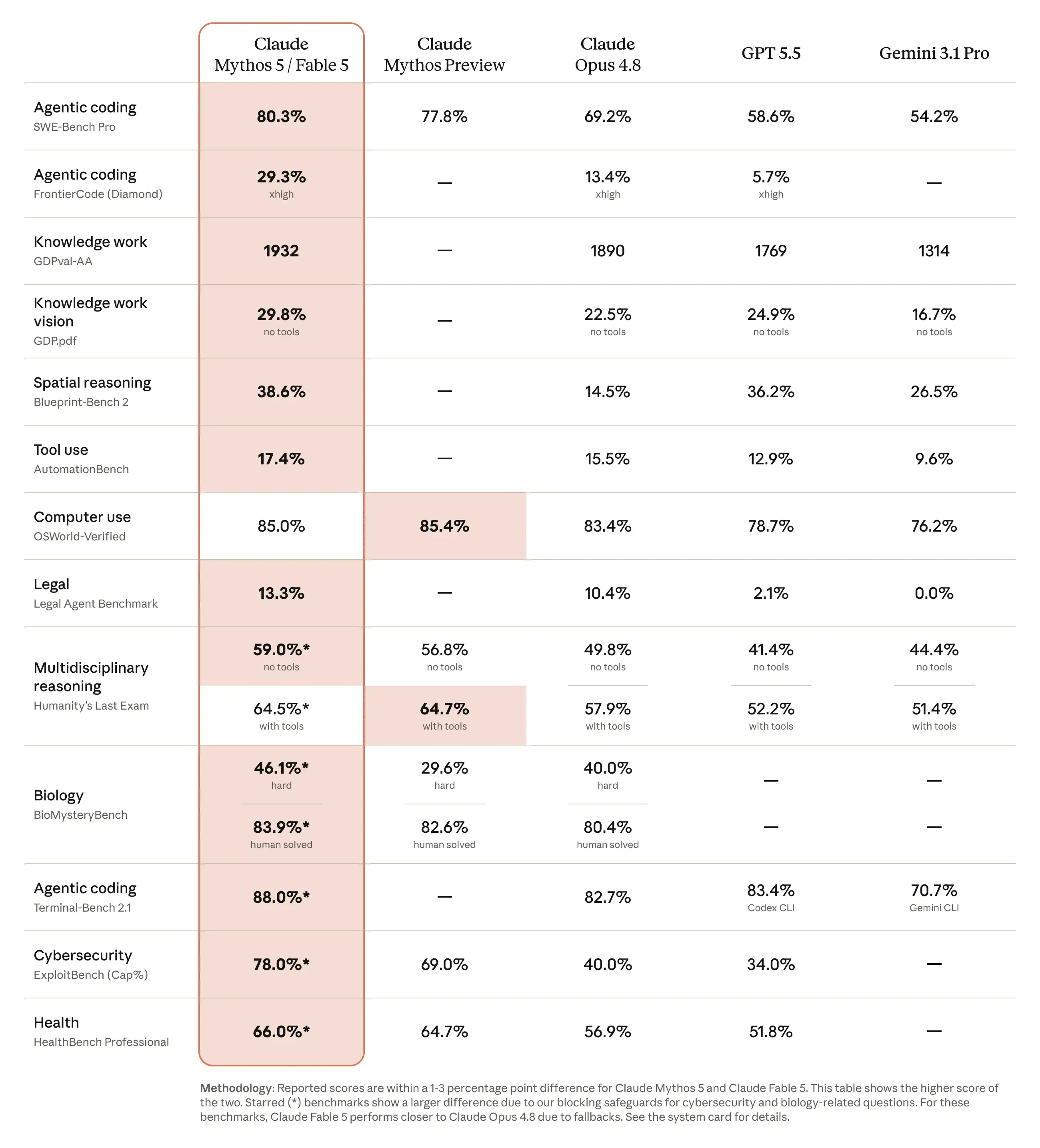
Sonnet 5 is not suitable to be used directly as the default model. Its performance is inferior to Opus 4.8, but it has received outstanding reviews for writing tasks.
Therefore, for large-scale, extensive code editing, you should stick to the Opus 4.8 series or use Fable 5 (which will no longer be available in the Claude Code Pro subscription after July 7).
When cost needs to be considered, when a newer knowledge base is required (updated to January 2026), and in small tasks or writing tasks, you can switch to Sonnet 5.
For simpler tasks, other more economical models will suffice.
What is Sonnet 5?
According to Anthropic's official announcement, Claude Sonnet 5 is the next-generation model in the Sonnet family, positioned as a 'state-of-the-art performance model for coding, agents, and professional tasks.' Anthropic placed it in the Sonnet product line rather than the higher-end, more expensive Opus or Fable flagship lines. This itself is a signal: Sonnet 5 is not designed to top benchmark leaderboards, but to be used 'every single day.'
Foreign media reports also note that Sonnet 5 is designed to be better suited for high-frequency daily use, with specific enhancements in browsing, coding, planning, knowledge work, and autonomous task execution. It has been rolled out simultaneously to all subscription tiers, including Claude Free, Pro, Max, Team, and Enterprise. This 'full release at launch' approach confirms its positioning as a workhorse model, not a niche feature.
In short, Sonnet 5 is not a 'highest-spec show-off model,' but the primary workhorse model Anthropic wants to push to most Claude users.
This aligns with Anthropic's historical positioning of the Sonnet series: stronger than Haiku, cheaper than Opus, and suited as a daily driver.
Social Media Feedback: A Complete Waste of Money
A chart from Artificial Analysis showing 'Cost per Intelligence Index Task' indicates that under Max thinking level, Claude Sonnet 5's single-task cost is significantly higher than models like GPT-5.5, GLM-5.2, Kimi-K2.6, DeepSeek-V4-Pro, and even higher than the Opus series. Some users quickly summarized it as:
Sonnet 5 should go straight to the trash bin.
1.2x more expensive than Opus 4.8 Max
2x more expensive than GPT-5.5-xhigh
5x more expensive than GLM-5.2
7x more expensive than Kimi-K2.6
57x more expensive than DeepSeek-V4-Pro
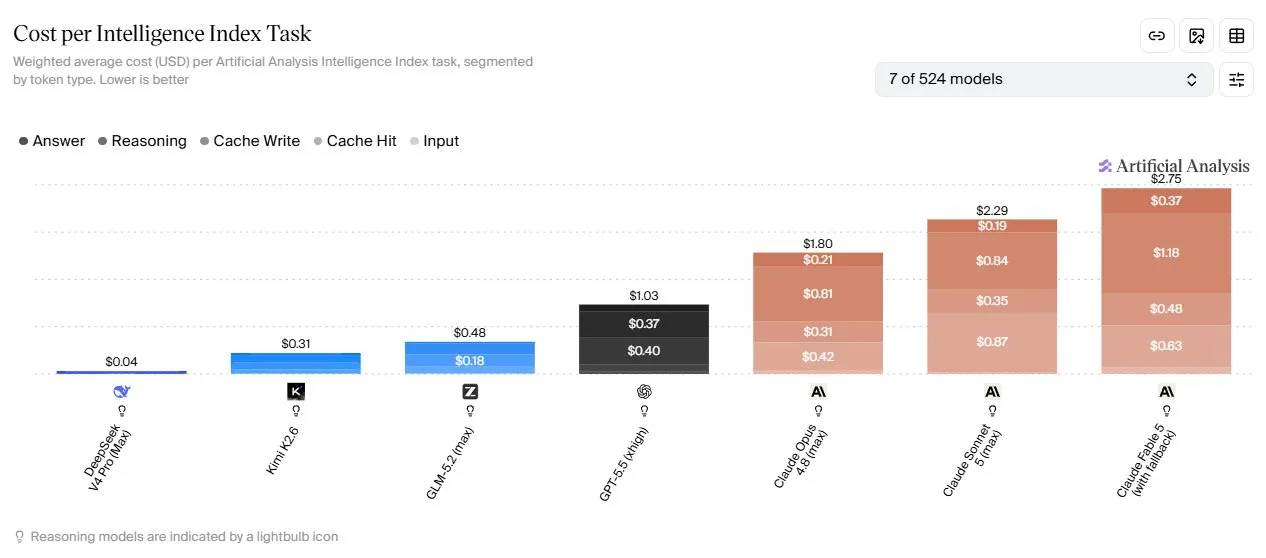
In response, Peter Steinberger, creator of OpenClaw, pointed out that price per token != actual task cost != final productivity cost.
Because Sonnet 5's intelligence hasn't made a massive leap forward, it needs to consume more tokens to complete tasks, making the total consumption higher than that of the Opus series.
Therefore, for large-scale code editing projects, it is better to directly use the higher-intelligence Opus series.
The Debate: Is Sonnet 5 Expensive?
Yes, it is.
Especially looking at it from the perspective of 2026, the cost pressure of Sonnet 5 is more obvious than in the past.
The cost chart from Artificial Analysis does not simply compare the input/output token unit prices. Instead, it is weighted according to Intelligence Index tasks, including different token types such as Input, Answer, Reasoning, Cache Write, and Cache Hit. It attempts to answer the question: how much does it cost on average to complete a standardized intelligence task?
This explains why models with seemingly similar API unit prices can have completely different actual task costs. For example, if a model requires an average of 3 rounds of tool calls—rereading the entire context each round to complete a task—while another model can yield a usable result in 1 round, the actual bill of the former will be several times that of the latter even if their unit prices are identical. The gap doesn't come from the pricing table; it comes from 'how many detours the model takes to solve a problem.'
If a model has:
- Longer outputs
- More reasoning tokens
- Heavier tool call chains
- Inability to get it right the first time, requiring iterative corrections
- Low cache utilization
Then its actual cost will be driven up.
This is why many people criticize Sonnet 5:
Anthropic's models are increasingly like luxury gas-guzzlers: high performance, but not cheap to run.
But Looking Only at Single-Task Cost Can Be Misleading
The catch is that developers rarely care about 'how much it costs to run a single benchmark.' Instead, they care about:
Will it save me from hassle?
When it comes to writing code, refactoring projects, analyzing repositories, fixing bugs, and running agents, the model cost is only one part of the total cost. What matters more is:
- Whether the first proposed solution is solid
- Whether it understands the context of a large project
- Whether it avoids modifying unrelated files
- Whether it maintains stability across long-running tasks
- Whether it can detect and correct its own errors
- Whether it reduces manual review and rework
If Sonnet 5 is significantly stronger in these areas than cheaper models, it might still end up being more cost-effective overall, even if its cost per task is higher.
To illustrate, consider a medium-sized refactoring task. A cheaper model might cost only a fifth of Sonnet 5 per token, but because it fails to grasp the project boundaries, it takes 6 rounds of trial and error to barely make it work, while accidentally breaking two unrelated files that you have to manually roll back. On the other hand, Sonnet 5 is more expensive but delivers a working solution in 2 rounds without touching unrelated files. Once you factor in your time spent troubleshooting, rolling back, and re-verifying, the 'total cost' of the cheaper model might not be lower than Sonnet 5—it's just that this cost doesn't show up on your API bill; it manifests as your wasted time.
It's just like cloud servers:
Cheap ones are indeed very cheap, but if they crash three times a day, suffer from IO throttling, or routing issues, you end up wasting valuable human hours.
The same goes for AI models.
Sonnet 5 True Value: Agents and Code Workflows
Judging from Anthropic's marketing focus, the core selling point of Sonnet 5 is not standard chat, but Agentic Workflows.
That is, enabling the model to not just answer questions, but execute tasks sequentially:
- Read project files
- Understand the existing architecture
- Formulate a modification plan
- Call the terminal
- Modify code
- Run tests
- Continue fixing based on errors
- Finally, summarize changes
This is precisely the capability that tools like Claude Code, Cursor, Windsurf, and OpenClaw rely on most.
For these scenarios, the model's 'adherence to instructions,' 'context stability,' and 'tool-calling judgment' are often more critical than simple Q&A. Anthropic's previous generations of Sonnet have had a great reputation in code agent scenarios. If Sonnet 5 continues to strengthen this trajectory, it will remain an indispensable tool for developers.
In complex projects, the issue with many models is not that they cannot write code, but rather that:
- They fail to grasp project boundaries
- They tend to rewrite entire files
- They break B while fixing A
- They make wild guesses when tests fail
- They lose track of context once it grows long
- They repeat the same incorrect fix when seeing an error
If Sonnet 5 can reduce these issues, then it is not just 'expensive' but 'expensive but hassle-free.'
Is It for Everyone?
No.
If your requirements are limited to:
- Translation
- Summarization
- Writing standard articles
- Generating short code snippets
- Asking general knowledge questions
- Light customer support QA
- Bulk processing of low-value text
Then Sonnet 5 is likely not the most cost-effective choice.
These tasks have entered a stage of 'model surplus.' Lower-priced models from GLM, Kimi, DeepSeek, and GPT can do them quite well. Especially for batch tasks, the cost difference will be amplified infinitely.
For instance, for a blog summary, a JSON conversion, or a standard SQL generation task, the benefits of Sonnet 5 may not offset its cost.
In these cases, a more sensible strategy is:
Use cheaper models for basic tasks, the Opus / Fable series for large and complex tasks, and delegate medium-complexity, small-scale tasks to Sonnet 5 when budget is a consideration.
My Recommendation: Don't Use Sonnet 5 as the Default Option Mindlessly
The best way to use Sonnet 5 is not to direct every single request to it, but to treat it as an economical utility model.
You can categorize tasks as follows:
1. General Text Tasks: Avoid Sonnet 5
For translation, polishing, modifying titles, writing summaries, and generating basic Markdown, cheaper models are more than enough.
These tasks do not require deep reasoning, tool calling, or project-wide understanding. Using Sonnet 5 here is overkill.
2. Basic Code Snippets: Case-by-Case
For writing simple functions, editing CSS, or generating a Docker Compose file, cheaper models can get the job done.
However, if they start failing repeatedly, or if you've already spent 10 minutes debugging, it is time to try switching to Sonnet 5.
The most expensive part of a cheap model is making you believe it is 'almost there.'
3. Medium-to-Small Code Tasks: Suitable for Sonnet 5
Examples include:
- Modifying a single page
- Creating a component
- Writing a helper script
- Fixing a specific, clear error
- Adding a simple API endpoint
- Generating test cases
- Performing minor refactoring on existing code
These tasks have clear boundaries, shorter contexts, and low costs of failure. Here, Sonnet 5 can leverage the Claude family's signature code understanding and instruction-following, while keeping the unit cost lower than Opus 4.8.
If the task is not complex, using Opus 4.8 might be wasteful; but if cheaper models keep stumbling, Sonnet 5 offers an excellent middle ground.
It is perfect for code tasks that 'need a bit of intelligence, but do not yet warrant the most advanced model.'
4. Large Project Development and Refactoring: Use Higher-Intelligence Models Directly
If your goal is not fixing a minor bug, modifying a component, or writing a quick script, but rather having AI help build a complete project, Sonnet 5 is likely not the optimal choice.
Such tasks typically involve:
- Building a complete application from scratch
- Designing project architecture
- Implementing multi-module features
- Modifying dozens of files sequentially
- Handling databases, authentication, state management, routing, and deployment configurations
- Running agent tools like Claude Code, Codex, or OpenClaw for hours
In these scenarios, what matters most is not 'low unit cost' but a 'high probability of getting it right on the first try.'
The cost of a large project consists of multiple components, not just token fees:
- The cost of the model understanding requirements
- The cost of maintaining context
- Rework costs from multiple rounds of edits
- Rollback costs from incorrectly modified files
- Troubleshooting costs after test failures
- Time spent on manual review and fixes
If a model's intelligence is slightly lacking, it might look capable at each individual step, but issues crop up when they are combined: it forgets the architecture designed earlier, breaks a newly written interface in the next round, or fixes page A only to break page B. Eventually, the project descends into a state of 'it runs, but don't touch it.'
This is why, for large-scale projects, you should prioritize higher-intelligence models like Opus 4.8 or Fable 5.
Although their unit prices are higher, they maintain global consistency much better in complex tasks, minimizing futile attempts and repetitive fixes. Especially when the task involves architectural design, cross-file refactoring, test fixes, and long-term context retention, the stability offered by more intelligent models outweighs the price difference.
Sonnet 5 is better suited for localized tasks:
Writing a page, modifying a module, generating some copy, adding a test, or fixing a specific error.
But if you are asking an AI to implement a large project from start to finish—especially running agents continuously for hours—a more reasonable strategy is:
Directly use Opus 4.8 or Fable 5. Don't compromise and hand the project to Sonnet 5 just to save a few pennies.
Because in large projects, the most expensive thing is continuing to trust the model after it makes a mistake.
The Catch with Sonnet 5: Anthropic is Still Anthropic
The release of Sonnet 5 also exposes Anthropic's long-standing issue:
The model is great, but the ecosystem and pricing cause anxiety.
Claude's experience has always been strong, particularly with code and long-context tasks. However, in terms of availability, quotas, regions, subscription limits, API costs, and third-party tool support, Anthropic is not as stable as OpenAI.
Moreover, as AI Agent consumption grows, the feasibility of 'unlimited use under a subscription' becomes harder to sustain. Previous analyses have pointed out that the actual API-equivalent cost consumed by power AI users can easily exceed the subscription price. A developer running agent tasks long-term might consume more tokens in a single day than the entire monthly subscription fee. This suggests that AI companies are highly likely to adjust towards more granular, cost-reflective billing methods in the future—such as stricter usage caps, tiered speed limits, or quiet price hikes on the output side, similar to what we see with Sonnet 5.
So, the issue with Sonnet 5 is not just about a single expensive model; it represents a broader trend:
Capable models will keep getting stronger, but the era of truly cheap, unrestricted use is coming to an end.
Summary in a Sentence
Sonnet 5 is neither a cheap model nor the strongest model, but a daily Claude model suited for writing and medium-to-small tasks. It occupies an awkward position in code editing: simple tasks don't require it, and complex tasks are better handled by Opus or Fable.
If you treat it as a cheap alternative to Opus, you might be disappointed;
If you view it as a Sonnet model better suited for daily text work and lightweight tasks, it is still a worthy addition to your toolkit.

Comments