
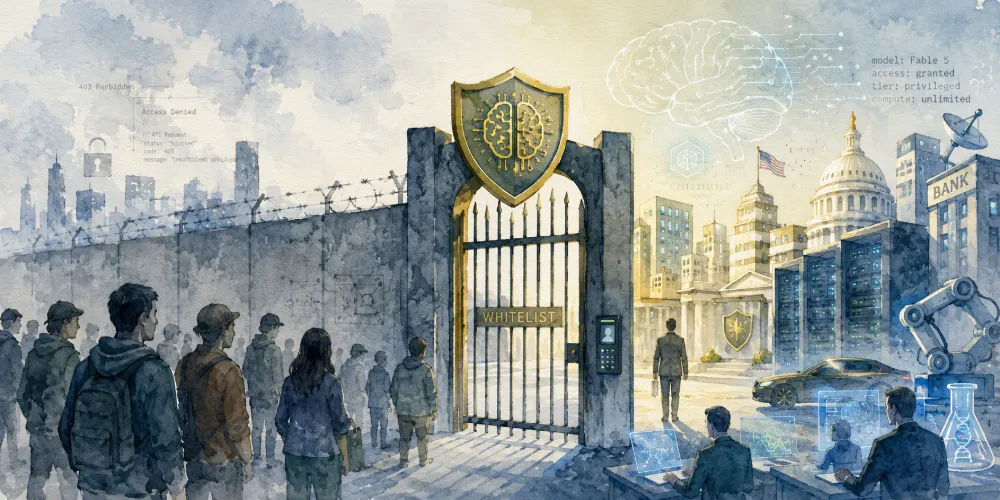
In the summer of 2026, the tech world experienced a massive "AI earthquake". An export control order from the US Department of Commerce instantly hit the pause button globally on Anthropic's flagship model, Claude Fable 5, and its underlying twin model, Mythos 5, which had just been released and were dominating major model benchmarks. Shortly after, following closed-door negotiations between government and business, select trusted entities and specific whitelisted organizations gradually regained their access privileges.
This historic event not only overturned developers' perceptions of cloud API stability but also declared a cruel truth to the world: a new cyber privileged class, chartered by the US government and intertwined with technology and power, has officially been born.
This also dealt a heavy blow to the entire AI industry — OpenAI's original utopian vision of democratizing technology and benefiting all of humanity has been thoroughly declared a failure.
1. The New Cyber Privileged Class Under the "Whitelist"
In the past, gold, oil, and land were the core factors of production. Today, in 2026, top-tier Artificial General Intelligence (AGI) reasoning compute has become the most scarce strategic resource.
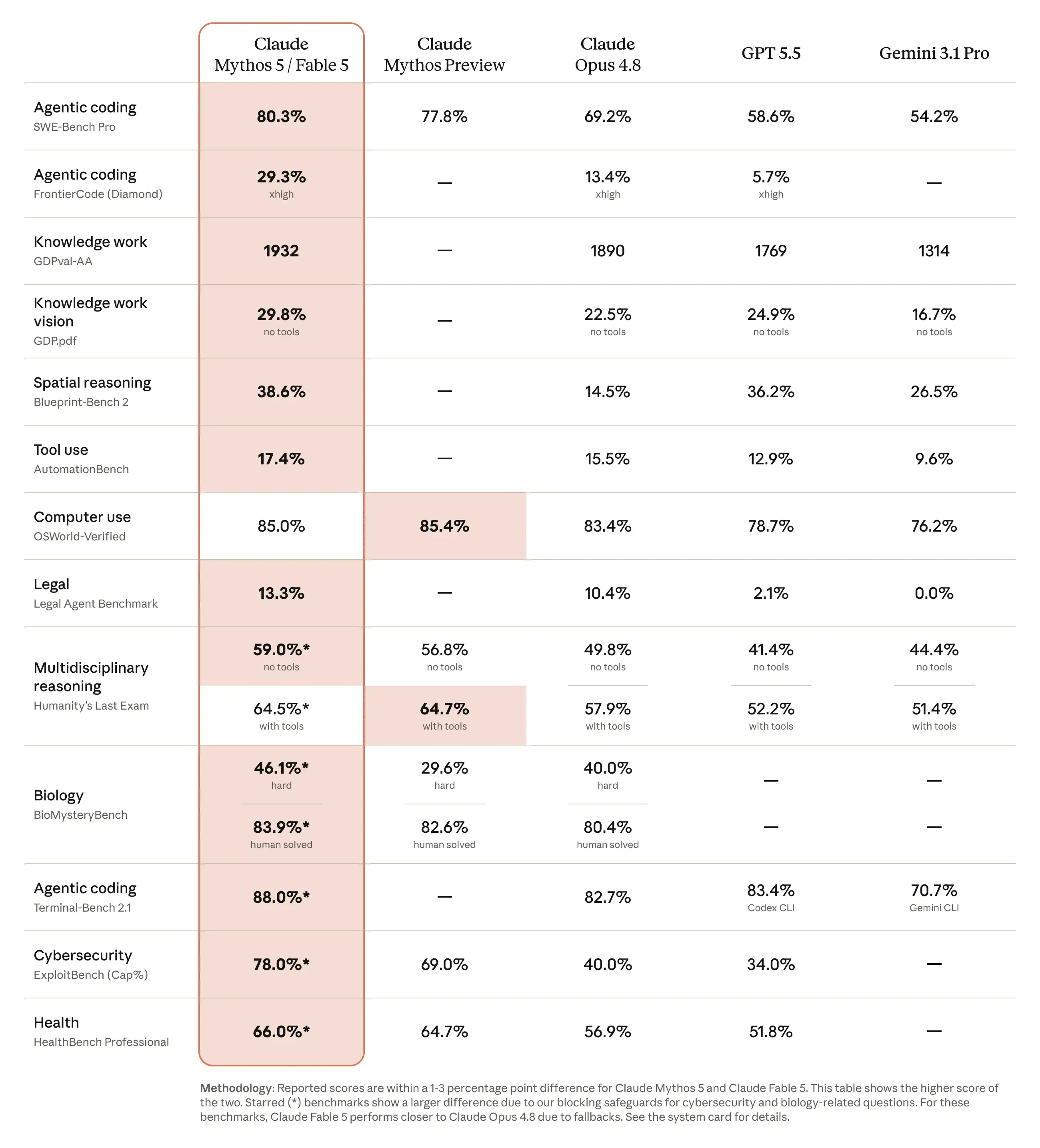
The formidable power of Fable 5 and Mythos 5 goes without saying — in cutting-edge benchmarks like TerminalBench 2.1, they demonstrated terrifying intelligence. Payments giant Stripe used it to complete a massive migration of 50 million lines of Ruby code in just one day, a task that would originally take an entire engineering team two full months; in the fields of biopharmaceuticals and cybersecurity, they even exhibited "near-godlike" abilities to bypass safety restrictions and autonomously run design tools.
However, precisely because of this "disruptive power", it attracted the iron fist of authority. The US government, citing national security, prevention of jailbreaks, and technology leakage, forcibly severed the connection for the public and overseas developers. The subsequently introduced "whitelist mechanism" corralled this power into the hands of a narrow privileged class:
- State Apparatus and Military-Industrial Giants: Possess absolute immunity and can make unlimited calls to the uncensored Mythos 5 without safety interceptors.
- Compliant Wall Street Plutocrats and Giant Multinational Corporations: Leveraging powerful lobbying capabilities and nationality screening, they have joined the "trusted compliance whitelist".
A Matthew effect of technological monopoly is forming: enterprises within the whitelist use Fable 5 to achieve efficiency leaps of hundreds or thousands of times, monopolizing industry wealth; meanwhile, small and medium-sized entrepreneurs, research institutions, and even the general public outside the whitelist can only watch helplessly as the technological generation gap is infinitely widened. The once egalitarian internet API ecosystem has turned into "rations" allocated by power, nationality, and capital. The US government's "charter" has officially carved out a new, superior cyber nobility in the global tech community.
2. The Entry of Power: The Agony of Fable 5's "Nationalization"
The Fable 5 whitelist storm marks the formal transition of AI technology from a "commercial competition phase" to a "geopolitical and national security phase".
"We don't believe this kind of government admission process should become the long-term default." — Facing strong government intervention, even OpenAI, which is preparing for its IPO, issued a feeble warning during the limited preview release of GPT-5.6 Sol.
But the struggles of capital and corporations seem insignificant in the face of the powerful state apparatus. In the past, Silicon Valley's tech elites always believed they could change the world through code, overriding geopolitics. But when the White House executes executive orders and the Department of Defense and NSA directly intervene in reviews, even a giant as strong as Anthropic can only choose to "actively cooperate with the government," to the extent that even its non-US citizen employees must be stripped of access rights.
Fable 5 is no longer just a commodity; it has become a strategic munition conscripted by the state.
3. Ideals in the Ruins: Shattered Dreams and Longing Amidst the Commercial Torrent
Looking back at the Fable 5 whitelist privileges, the restricted review of OpenAI's GPT-5.6, and OpenAI's own IPO application, history completes a massive irony at this moment.
In 2015, when Elon Musk, Sam Altman, and others founded OpenAI, its core mission was:
To act as a non-profit organization, unconstrained by financial return, ensuring that AGI technology is open to all, preventing the technology from being monopolized by a single country or giant plutocracy, thereby benefiting all of humanity.
Today, this vision has been shattered into rubble:
From non-profit to capital darling: OpenAI has long since transformed into a profit-seeking entity, moving towards an IPO to cater to the capital market; its original non-profit utopian ideals have long been swallowed by commercial logic.
From "Open" to "Closed": The once open-source promises have become the most closely guarded commercial secrets, and now, under government directives, have evolved into a fractured ecosystem of "whitelist admission".
From benefiting all of humanity to serving a privileged class: Top-tier large models are no longer tools that universally benefit humanity, but have become private property used to strengthen the hegemony of specific countries and enhance the productivity of a few monopolistic giants.
However, that initial glimmer of light still fills us with longing
Even if the reality is so cold, and even if OpenAI has now substantially transformed into a profit-seeking entity, when we brush away the commercial noise and look back at its original vision, that grand blueprint of "universal access to technology" still radiates a soul-stirring idealistic glow.
It was a rare and great attempt in the history of human technology to transcend national boundaries and class barriers. It promised the world a possibility: the highest dimension of intelligence does not need to be subservient to power, and cutting-edge technology can become a weapon for every ordinary person to fight fate and bridge the digital divide.
It is precisely because this original vision was once so beautiful, even offering us a fleeting glimpse of a cyber utopia's dawn, that the sense of loss and pain in the hearts of global developers feels so acute today when facing the "whitelist high wall" of Fable 5. People's yearning for OpenAI's original intention is not out of naive commercial fantasies, but stems from humanity's deep-rooted desire for fairness, openness, and borderless knowledge. This very yearning has become the most resilient spiritual spark in fighting technological monopoly and calling upon the power of open source today.
Conclusion
The "whitelist storm" of Fable 5 reveals the future landscape of the AI era: technology is no longer flat, but fragmented by high walls built by power.
OpenAI's original humanist vision has failed, replaced by a colder, more Darwinian reality. In this new cyber order chartered by the government and built on whitelists, whoever can get that "special pass" to top-tier computing power will hold the power to rewrite the world in the next era. The remaining vast majority are inevitably being reduced to "digital commoners" under this technological collusion.
However, the situation is not entirely without a turning point. Top Chinese open-source models, represented by GLM 5.2, are showing increasingly strong competitiveness. If they can continue to catch up or even surpass closed-source whitelisted models in key capabilities such as coding, reasoning, tool calling, and long context, global developers will at least not be forced to completely rely on a few US APIs. Their strong performance is expected to alleviate, to some extent, this technological class polarization jointly created by computing power, capital, and state power.

Comments