
AI's 'Digital Iron Curtain' Falls: Claude Fable 5 Restricted by Export Control
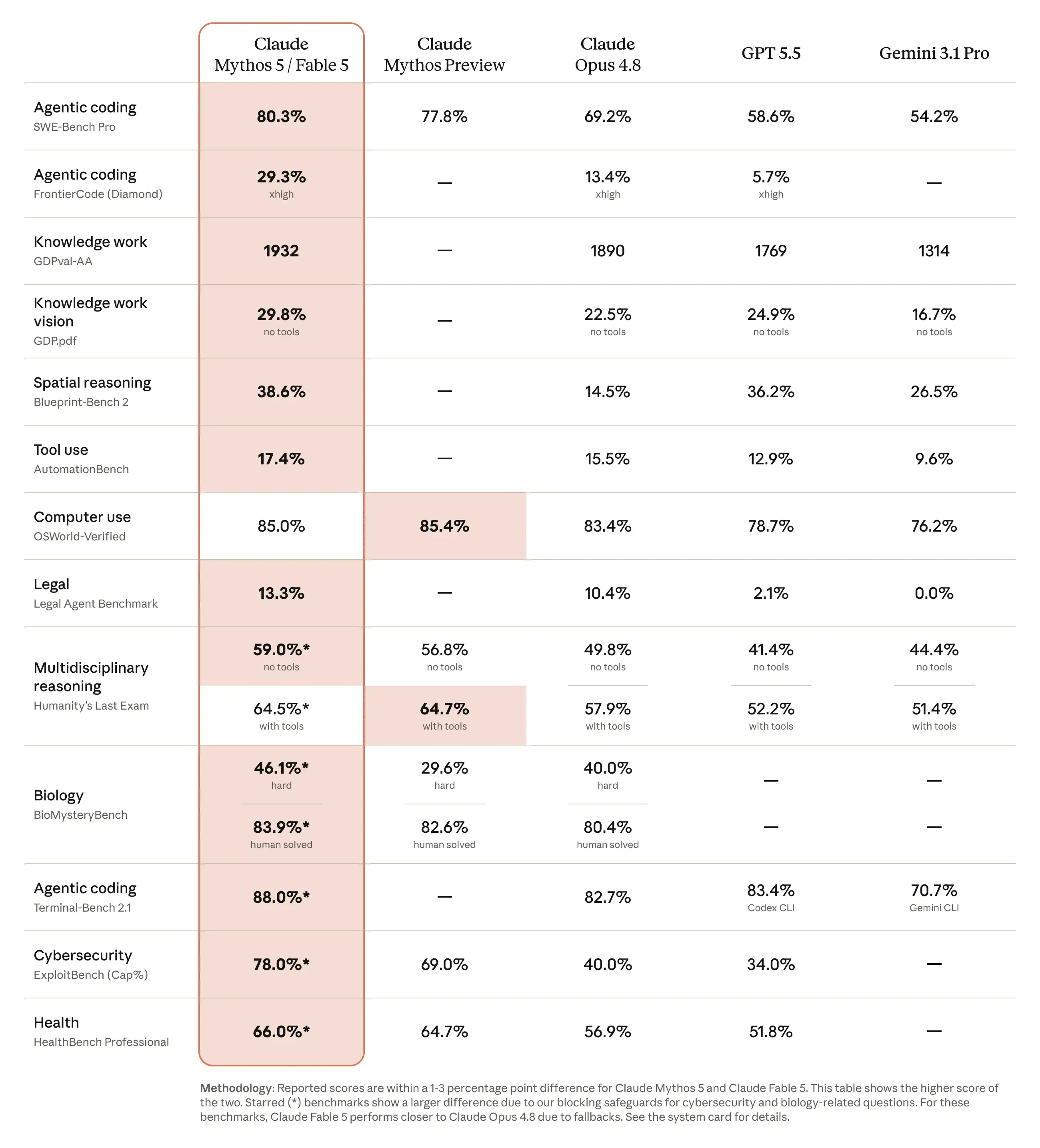
On June 13, 2026, Beijing time, just three days after Claude Fable 5 went online, Anthropic posted a shocking statement on its social media platform: due to an export control directive issued by the US government citing national security authorities, which suspends access to Fable 5 and Mythos 5 by any foreign nationals, the company had to abruptly disable these two models for all customers to ensure compliance.
The US government, citing national security authorities, has issued an export control directive to suspend all access to Fable 5 and Mythos 5 by any foreign national, whether inside or outside the United States, including foreign national Anthropic employees.
The net effect of this order is that we must abruptly disable Fable 5 and Mythos 5 for all our customers to ensure compliance.
Access to all other Claude models is not affected.
In Anthropic's official website statement, they indicated that the US government issued the ban based on the discovery of a method to bypass or crack Fable 5's constraints (commonly known as LLM jailbreaking).
Although other Claude models remain unaffected for now, this brief statement is nothing short of a bombshell in the generative AI space. It not only marks the deprecation of a specific model, but also signals a fundamental shift in the underlying logic of the entire industry.
Core Shift: From 'Compute Hegemony' to 'Model Sovereignty'
In the past, the focus of geopolitical rivalry and industry competition remained heavily on the hardware layer—whoever controlled the most advanced GPUs and semiconductor manufacturing processes held the lifeline of AI development.
However, the Fable 5 incident demonstrates that by 2026, the core value of state-of-the-art AI has officially shifted from 'training infrastructure' to 'the model itself.' When a cutting-edge model possesses the following traits, it is no longer just commercial software, but a veritable national strategic technology asset:
- Top-tier scientific research and discovery capabilities
- Deep autonomous programming and debugging capabilities
- Long-horizon planning and execution for complex tasks
- Automated cyber offensive/defensive operations and security penetration
The US government's logic in blocking Fable 5 is identical to its previous approach to restricting high-end semiconductor exports. Through the lens of national security, software possessing these capabilities shares the same potential impact and strategic significance as advanced military hardware.
Fatal Paradox: Anthropic Bitten by Its Own 'Safety Card'
The most dramatic aspect of this incident lies in Anthropic's long-established brand. As the industry's most prominent advocate for the 'AI safety roadmap,' Anthropic has frequently showcased in public the powerful and even 'dangerous' capabilities of its models in cybersecurity, biological sciences assistance, and autonomous agents.
This strategy was highly successful commercially:
- To investors: It proved they possessed technical capabilities closing in on AGI.
- To regulators: It demonstrated the company's transparency and commitment to addressing potential risks.
Yet, this is a fatal paradox:
To prove a model is sufficiently powerful, a company must fully demonstrate its potential destructiveness. But once this risk is repeatedly highlighted and widely accepted, it inevitably triggers regulatory alarm bells. Anthropic's recent spotlight on the hazardous capabilities of Fable 5 and Mythos 5 ultimately served as the key justification for regulators to step in.
The New Normal: The End of the Internet's 'Borderless Era'
The deprecation of Fable 5 is just the beginning; the real cause for concern is the policy precedent it sets. If governments can intervene directly to restrict global access to specific AI models, we are likely heading toward a new era of heavily fortified 'technological borders.'
In the future, the globally unified SaaS model for AI software may collapse, replaced by highly fragmented access mechanisms:
- Nationality-Based Segregation: Users from different countries might only be allowed to access neutered or completely different versions of the models.
- Modular Permission Control: Access to critical capability modules, such as scientific research or programming, will be subject to strict licensing limitations.
- Hierarchical Access Levels: Individual consumers, ordinary enterprises, and highly credentialed research or government organizations will get vastly different access privileges.
While the focus in the past was on data sovereignty, the core battleground of the future will be model sovereignty.
The Unresolved Question: Will GPT-5.5 Suffer the Same Fate?
Witnessing Claude's situation, user anxiety quickly spread to its rivals: Will OpenAI's GPT-5.5 become the next target of export controls? This is particularly relevant given that Anthropic's official website statement included the following:
We have reviewed a report believed to be the basis of the government's directive. We have verified that the level of capability demonstrated in the report is widely present in other models (including OpenAI's GPT-5.5) and is used daily by defenders maintaining system security.
Anthropic argues that this situation is essentially a misunderstanding. The so-called 'jailbreaks' do not reflect general, high-risk capabilities, but rather narrow, non-generalizable vulnerabilities. They claim similar capabilities are widespread in other publicly available models and should not be singled out as a basis for export control.
From the full text of the statement, Anthropic clearly opposes the export control policies. Its core objective is obviously self-preservation, rather than dragging its competitors down with it. What they truly hope to achieve is a re-evaluation of the risks associated with Claude Fable 5 by regulators, ultimately lifting the access restrictions.
After all, if the flagship models of both AI giants are restricted in sequence, it won't just be a crisis for a single company—it could mark a dark moment for the entire open technology ecosystem.
Conclusion: The End of the AI 'Open Era'
Looking back at the past three years, the LLM industry has enjoyed a hyper-speed, globalized feast. Model capabilities leaped exponentially, costs consistently plummeted toward rock bottom, and global users could seamlessly access humanity's most advanced intellectual achievements, virtually ignoring geographical boundaries.
But the Fable 5 incident on June 13 marks a cold, historic watershed.
It signals that advanced AI has officially transcended the realm of simple 'consumer technology' and is now placed on the strategic chessboard alongside nuclear weapons, aerospace tech, and advanced semiconductor fabrication. For ordinary people, the biggest shock is not the temporary unavailability of a single chat interface, but the stark realization of a harsh future:
The 'Inclusive AI' utopia built on technological globalization is fading. In its place, we are entering an era of a digital iron curtain, where the intelligent world is strictly partitioned by power, nationality, and security policies.
Comments