
Once, countless people frantically hoarded graphics cards for Bitcoin and Ethereum, turning their homes into roaring mining farms. As the era of traditional cryptocurrency GPU mining gradually cooled down, many assumed the days of earning passive income using personal computers were over. However, with the explosion of the generative AI era, a brand-new "mining" model is quietly emerging—AI node inference power sharing.
Recently, along with advances in local model capabilities, the emergence of the Darkbloom platform has revealed this potential path. In this new era, instead of calculating meaningless hashes, you turn your computer into a piece of AI infrastructure, earning revenue by running Large Language Models (like Gemma 4 26B) for real users. In this new game, Apple's Mac computers, powered by their high-bandwidth unified memory architecture, have unexpectedly become the perfect "mining rigs."
Introduction to Darkbloom
Darkbloom.dev can turn your MacBook into a revenue-generating private hardware node network. Users simply install a command-line interface (CLI) on their Mac, and the device will automatically receive and process AI inference requests when idle. Developers can call this distributed computing power through an OpenAI-compatible API. For every token generated by the device, node operators earn dollar-denominated revenue.
The technology behind this project comes from Eigen Labs, and the related paper and code have been open-sourced. Its key selling point is allowing consumer Apple Silicon devices to participate in the AI inference market while preserving the privacy of user requests.
Link: https://github.com/Layr-Labs/d-inference/blob/master/papers/dginf-private-inference.pdf
Turning a Mac into an AI Server: How Much Can You Actually Earn?
According to the creators, node operators receive 95% of the inference revenue, with the platform taking a 5% cut.
Aside from the hardware itself, the only operational cost is electricity, and Apple Silicon consumes very little power. Even under full inference load, it costs only $0.01 to $0.03 per hour. It's like leaving a single lightbulb on.
Let's look at the earnings estimates provided by Darkbloom:
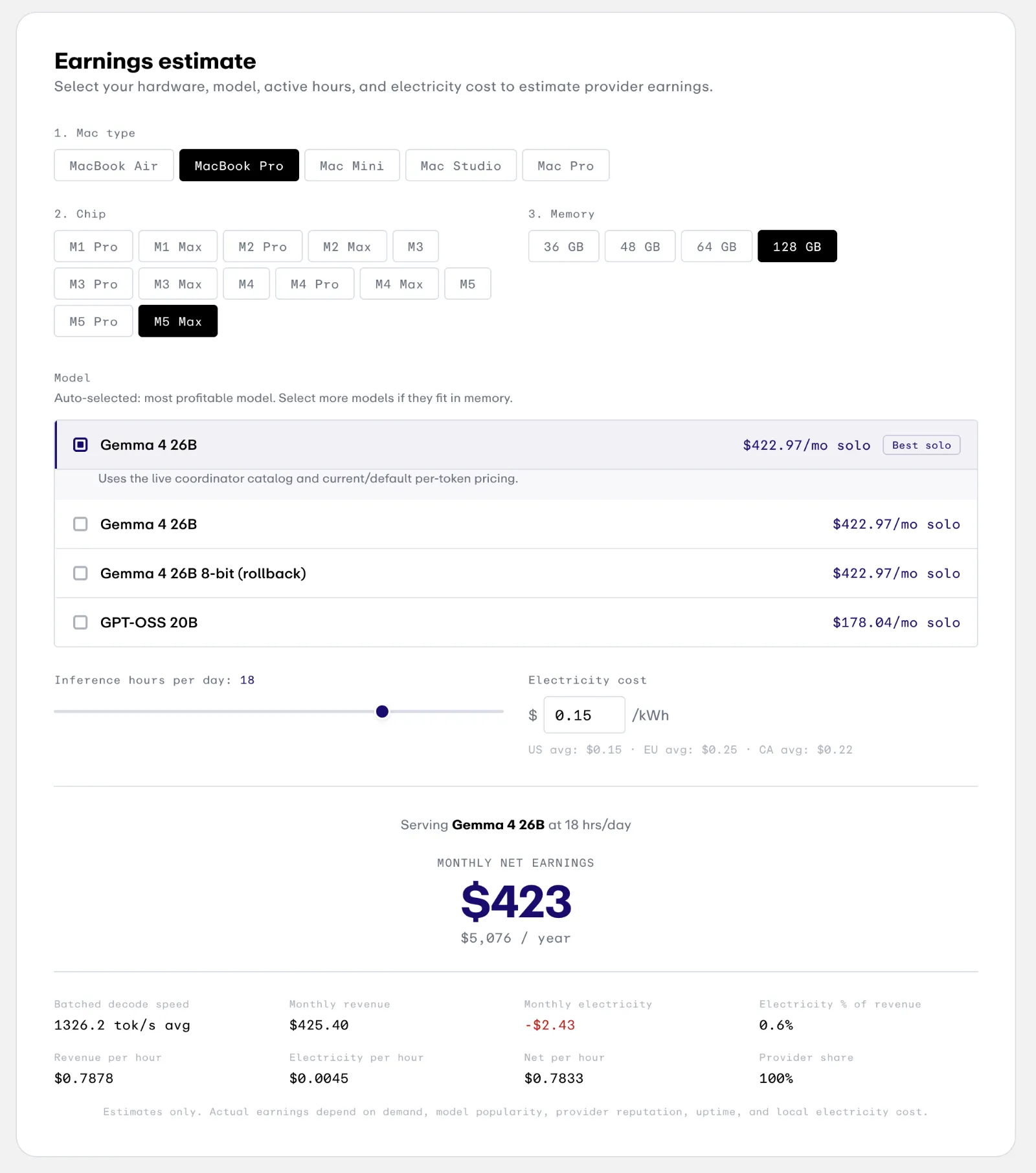
1. The Top-Tier Money Machine: MacBook Pro (M5 Max, 128GB Unified Memory)
If you own a high-end MacBook Pro configured with an M5 Max chip and 128GB of RAM, this machine is practically built for running LLMs. Its massive memory pool can easily accommodate and even concurrently process large models.
- Operating State: Running 18 hours a day (e.g., idle time after work).
- Processing Speed: Batch decoding speed reaches a staggering
1326.2tok/s. - Monthly Earnings: Estimated gross monthly revenue is around $425.40. After deducting electricity costs, the net monthly earnings are about $423!
Over a year, that adds up to $5,076. Since an M5 Max + 128GB RAM + 2TB version currently retails for $5,399 on the official Apple store, this revenue is not only enough to recoup the cost of purchasing the computer, it's essentially equivalent to the Mac working to pay off its own loan.
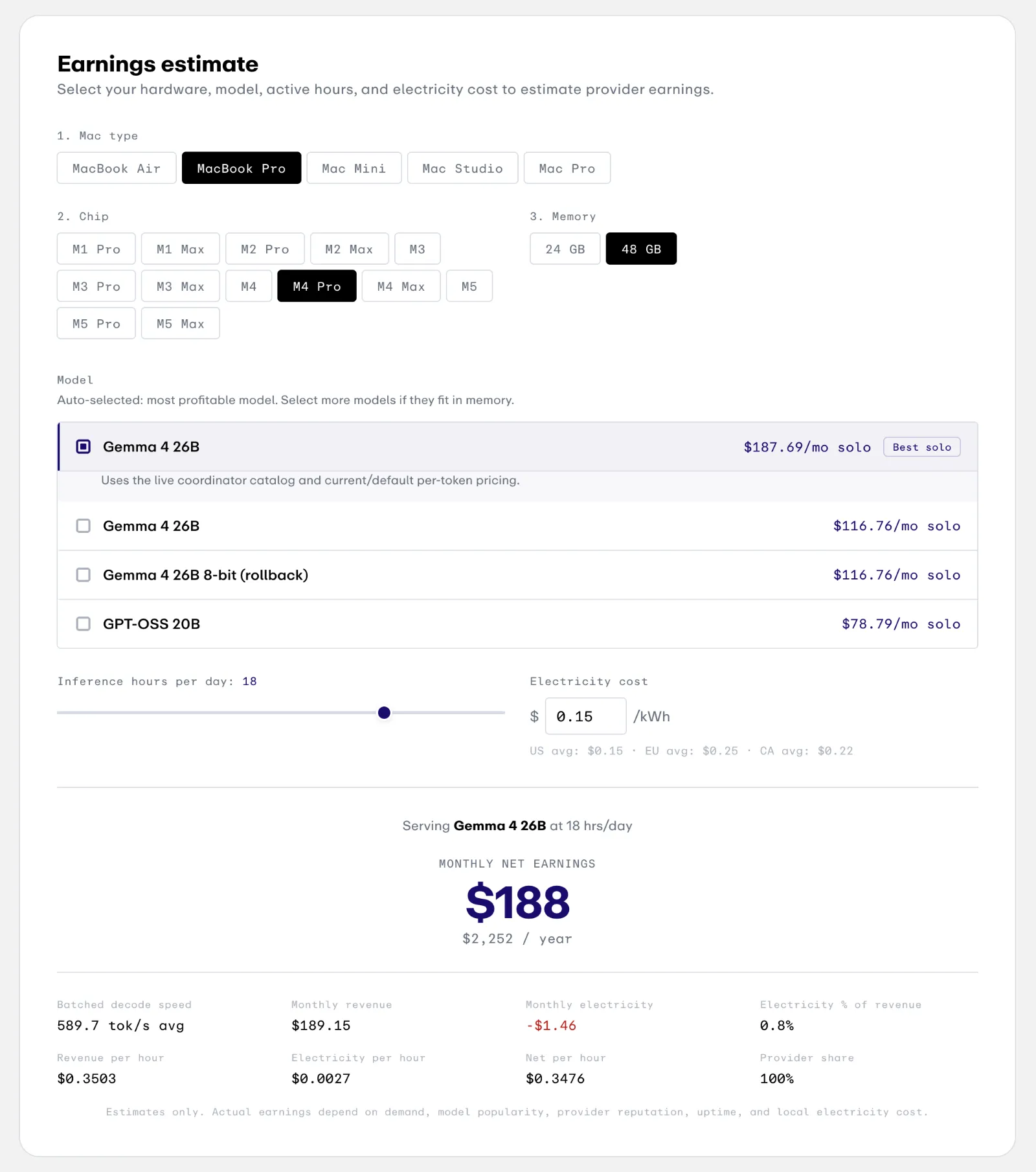
2. The Mid-Range Workhorse: MacBook Pro (M4 Pro, 48GB Unified Memory)
If you are using a mainstream workstation setup, such as the version configured with an M4 Pro chip and 48GB of RAM:
- Operating State: Also running 18 hours a day.
- Processing Speed:
589.7tok/s. - Monthly Earnings: You can still earn a net income of approximately $188 per month.
That's $2,252 a year. For passive income generated purely by utilizing the computer's idle time, this is an excellent stream of extra pocket money.
The Mind-Blowing Energy Efficiency of Apple Silicon
The biggest headaches of traditional mining are high electricity bills and the noise of fans spinning at full blast. In this new era of AI mining, however, Apple's M-series chips display a truly mind-blowing energy efficiency ratio.
Assuming an electricity rate of $0.15/kWh, the M5 Max MacBook Pro that earns you $425 a month consumes only $2.43 in power over the entire month; the monthly power bill for the M4 Pro version is even lower at $1.46. The electricity cost represents less than 1% of the total revenue. There are no screaming fans, no sky-high utility bills—only the elegant silence of running large models in the background to generate income.
Compute demand in the AI era is practically infinite, and decentralized consumer computing networks might just be the next gold mine. Your Mac is no longer just an expensive productivity tool—it has full potential to become your "digital employee."
Summary & Risk Warnings
Naturally, as with any emerging domain, we should maintain realistic expectations. Currently, platforms like Darkbloom have sparked open discussions across developer communities like Hacker News, Reddit, and LinkedIn. The good news is that there are no reports of scams; however, according to feedback from early node testers, the tasks allocated in the network are still predominantly "Health Checks," meaning actual commercial inference demand remains low. Consequently, the high predictions provided by the official calculator are relatively optimistic.
More importantly, the pace of advancement in LLMs is blistering. The open-source community has already iterated to massive yet efficient models like Gemma 4 26B. Architectural algorithms, quantization methods, and throughput optimizations are updated almost monthly. While today's hardware configuration might be perfectly aligned to reap the benefits, in three months, the launch of even larger and more powerful models could completely redefine the bandwidth and hardware requirements across the network.
This is bound to be a race against technological evolution. Future actual earnings will be heavily dependent on the growth of real-world commercial request volume, the speed of model updates, and the platform's ongoing operations.
Please remember that the data above is for reference only. You can look at these estimated figures as an interesting reference.



Comments